Trump’s stunning campaign rewrote all the rules. What about his presidency?
Jerry Adler 1 hour 49 minutes ago
He was helped by running against a deeply unpopular opponent. Historians will debate how much damage was done to Hillary Clinton during the week that the FBI kept the country in suspense over a renewed investigation of her emails, but her troubles with the electorate began long before and ran deeper. She took a hit in the primary from the left wing of her party, and analysts will be poring over exit polls to figure out whether the Sanders voters defected in numbers large enough to affect the outcome. But in the end, Americans just didn’t like or trust Clinton, and the chance to make history by electing the first woman president of the United States didn’t bring enough women to her side to offset Trump’s huge advantage among white men.
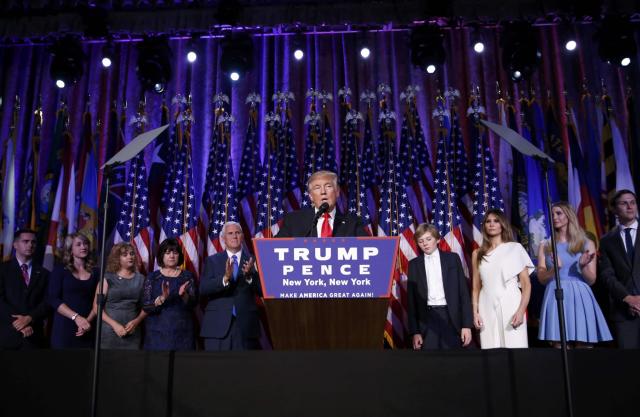
Even some in Trump’s inner circle were “shocked,” as one aide put it, watching the results roll in to the candidate’s headquarters in Trump Tower. “I had hoped for this,” one campaign source said. “I knew there was a chance for this, but I gave it a 30 percent chance. I thought we would come up just short.” His indefatigable campaign manager, Kellyanne Conway, had begun the evening making pre-emptive excuses for a loss, complaining to Chuck Todd of NBC that “We didn’t have the support of the full Republican infrastructure.” But midway through the night, she was revising that opinion, telling reporters that the Republican National Committee had been an “excellent partner” to the campaign. “Absolutely buoyant. We can smell the win,” Conway texted to Yahoo News.
The mood was jubilant at Trump’s victory party at the New York Hilton, where cheers were punctuated by shouts of the de-facto Trump campaign slogan — “Lock her up!” — and, in honor of FBI Director James Comey, who may have helped turn voters away from Clinton: “Comey! Comey!”
Did the Clinton campaign sense the unfolding disaster? In the late afternoon, Clinton campaign manager John Podesta was spotted stalking through Times Square with a grim frown. The mood at the Javits Center — where Clinton expected to give a victory speech under New York City’s largest glass ceiling —shifted from confident celebration, to concern, to grief, as Tuesday wore on. The campaign’s uplifting videos, featuring Clinton’s childhood friend testifying to her “goodness,” jarred with the increasingly downcast mood of the crowd.
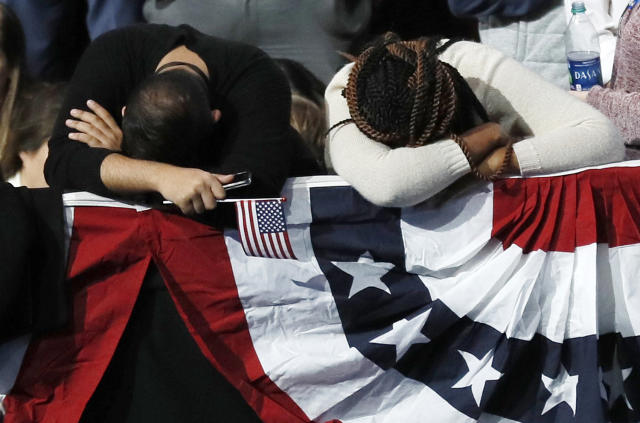
At the beginning of the night, the Clinton campaign told reporters that the candidate and her entire family were watching returns come in at a nearby hotel. An aide even described the outfit Clinton’s granddaughter was wearing, providing colorful details to her press corps. But starting at about 10 p.m., the campaign went silent, and even lower-level campaign aides disappeared from the Javits Center. Around 2 a.m., Podesta appeared briefly at the podium to send the crowd home; the campaign would have more to say Wednesday morning.
Meanwhile, Clinton’s surrogates started to confront the prospect of defeat.
Julián Castro, the U.S. secretary of housing, looked depressed as he contemplated a Trump presidency around 1 a.m. Tuesday night in the somber Javits Center.
“If Donald Trump wins, aside from the politics, the immediate concern is that he become a leader and a president and not just a campaigner,” Castro said, adding that Trump has an “enormous” responsibility to become steadier as president.
When asked if he believed Trump would build a wall on the U.S.-Mexico border, Castro replied: “My hope is that would never happen.”
“What you saw today was not a mandate for every little utterance he made like building a wall or having a deportation force,” Castro said. “I believe it was an expression of a desire for change.”
Meanwhile, former Gov. Howard Dean of Vermont told Yahoo News via e-mail that the surprise upset was “a successful populist revolt,” and adding that he believes NATO “is in danger.” Asked what went wrong with Clinton’s campaign, he replied, “Who knows?”
____
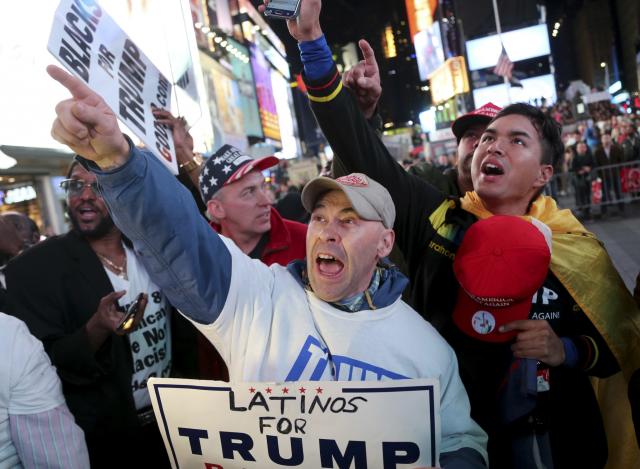
The reverberations were felt around the world, as stock markets and the dollar plunged in reaction to a victory of a candidate who had run a campaign against international finance and free trade. The Mexican peso took the biggest hit of all, and gold, the traditional refuge of capital in turbulent times, soared.
Trump alienated immigrants, made enemies of Muslims, insulted and mocked women, and still won. He left unchallenged the belief that he had avoided paying federal income taxes for years, he faced plausible, if unproven, accusations of running a fraudulent business (his “Trump University”) and he retweeted racist and anti-Semitic images and memes — and still he won.
Hillary Clinton, who had come in for praise — including from Trump himself — as an effective senator and secretary of state while she held those offices, was endorsed by practically every newspaper in the country. She raised far more money than he did and campaigned with a popular president, with her own chief opponent in the party, with Beyoncé and Bruce Springsteen — and still she lost.
Trump will take office under a cloud of litigation, including the lawsuits he has vowed to file against 11 women who have accused him of making unwanted sexual advances. Gloria Allred, who represents several of the women, said she assumes that as president-elect, Trump will have better things to do. But there are also lawsuits charging that his eponymous “university” was a scam that bilked students out of thousands of dollars of tuition. One of those is scheduled to go to trial on Nov. 28, before U.S. District Judge Gonzalo Curiel, whom Trump has claimed cannot preside impartially over the case, given his Mexican heritage. If Trump abides by his promise not to settle the suit, he will have to appear in court in person.

Michael Flynn, the retired U.S. Army general who has served as Trump’s chief foreign policy adviser, seems a likely candidate to become Trump’s national security adviser or possibly director of national intelligence.
There are a few other outsize personalities close to Trump who can be expected to play big roles: Former House Speaker Newt Gingrich or New Jersey Gov. Chris Christie could be in the running for chief of staff.
But mainstream Republican officeholders like Paul Ryan, the speaker of the House, don’t share most of Trump’s agenda — and many of them, including Ryan himself, are reliably said to detest him personally. The foreign policy wing of the party was appalled by Trump’s ascent, regarding him as naively fixated on trade issues with Mexico and China, and dangerously unconcerned about the threat of a resurgent Russia. But the party has a platform that includes tax cuts for the top income brackets, repealing Obamacare, drastically pruning business and environmental regulation, and reversing the Obama administration’s climate-change initiatives. Undoubtedly to their surprise, they now appear likely to get all that — along with a border wall, a deportation force and an unpredictable president with almost no grounding in policy or connections to party leaders. It may turn out to be a lesson about being careful what you wish for — but it is a problem the Democrats can only wish they had instead.
Reporting by Liz Goodwin, Hunter Walker, Michael Isikoff, Holly Bailey and Lisa Belkin.
_____
Related slideshows:
Trump defeats Clinton in 2016 election >>>
Election Night in America! >>>
Americans go to the polls to elect the 45th president >>>
Hillary Clinton and Donald Trump hold final rallies on Election Day eve >>>
Donald Trump’s America, Part 2 >>>
Donald Trump inspires his own brand of fashion on the campaign trail >>>

No comments:
Post a Comment